
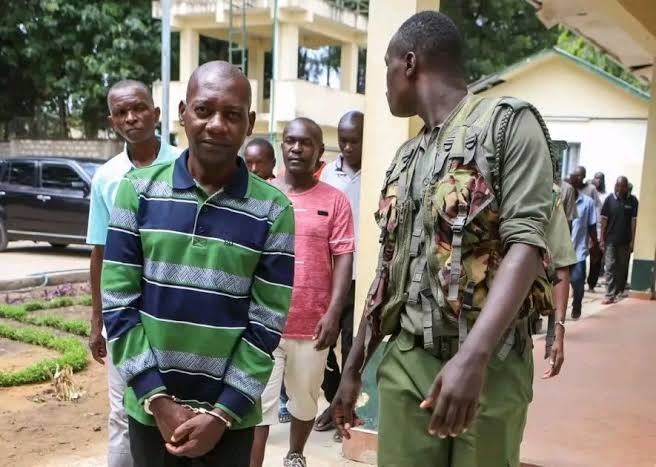
Before investigators uncovered hundreds of bodies in Kenya’s Shakahola Forest, authorities had already received years of warnings about Paul Mackenzie. Now, a 200-year prison sentence confirms the horrifying truth: children were deliberately targeted, some victims were murdered by direct violence, and the danger was known long before the graves were discovered.
Stephen Mwiti still has photographs of his six children. He has kept their school uniforms, too.
They are among the few things he has left.
His children disappeared into Kenya’s Shakahola Forest after their mother joined a religious movement led by a self-proclaimed preacher named Paul Nthenge Mackenzie. According to Mwiti, all six died there. Only one, a young boy named Samuel, has been identified and returned to his family.
On November 6, 2026, a Kenyan court sentenced Mackenzie to 200 years in prison for the murders of 190 children and one adult.
For Mwiti, the sentence could never undo what happened.
But the court’s findings revealed something far more disturbing than the story of a religious leader who convinced his followers to starve themselves.
Children had been ordered to die first. Those who resisted could be beaten or confined. Some victims didn’t starve to death at all. They were killed through direct violence.
And perhaps most troubling of all, authorities had known about Mackenzie for years.
He had been arrested before. Families had raised concerns. Reports had been made to police and government officials.
Yet hundreds of people ultimately ended up buried in a remote forest.
The question is no longer simply how Mackenzie convinced people to follow him.
It is how a system capable of killing so many people, including children too young to understand what was happening, was allowed to continue despite repeated warnings.
The Children Were Supposed to Die First
Paul Mackenzie founded the Good News International Church and built a following around increasingly extreme religious teachings.
He told followers that the end of the world was approaching and that dying through fasting would allow them to meet Jesus.
His message went beyond religious devotion.
Mackenzie discouraged formal education and medical treatment. Followers abandoned schools, jobs and, in some cases, their homes. Some sold property before relocating to an isolated settlement in the Shakahola Forest, near Kenya’s Indian Ocean coast.
The settlement offered an escape from a world Mackenzie had taught them to fear.
What followed was not the peaceful spiritual community they had been promised.
According to findings delivered by Kenya’s High Court on October 19, 2026, Mackenzie directed followers to fast to death in a specific order.
Children first. Then young people, women and finally men.
That detail changes the entire understanding of the massacre.
Adults who embraced Mackenzie’s teachings may have believed they were making a religious sacrifice. But children had no meaningful ability to consent to starvation or escape the adults controlling their lives.
A child cannot choose a different belief system when the people responsible for feeding them have decided that food is forbidden.
The court found that the deaths were part of an organized system of enforced fasting, not simply a series of voluntary religious decisions.
During sentencing, Justice Diana Kavedza described the ages of the victims.
Among them were 161 infants, toddlers and children younger than approximately nine and a half years old. Another 22 were between 10 and 13.
The youngest was just 12 days old.
Twelve days.
A baby who had barely begun life became one of the victims of a movement that claimed death was the path to salvation.
And as investigators examined what happened in the forest, they discovered that starvation was only part of the story.
Some Victims Were Murdered Without Starving
The Shakahola massacre became internationally known as a mass-starvation tragedy.
But that description doesn’t tell the whole story.
During the criminal proceedings, prosecutors presented evidence that Mackenzie and his associates used violence to enforce the fasting instructions.
Followers who resisted could be threatened, beaten or confined. Guards helped prevent people from escaping or breaking the rules.
Forensic examinations revealed that some victims had injuries consistent with strangulation and other forms of violence.
The court ultimately distinguished between 183 murders by starvation and eight murders by direct homicide.
Those findings were reflected in Mackenzie’s sentence: 100 years for the starvation murders and another 100 years for the direct killings, to be served consecutively.
This was not simply a case of people being persuaded to stop eating.
The court established that Mackenzie directed a system in which deprivation and violence were used to bring about death.
And he wasn’t working alone.
The prosecution identified a hierarchy of associates who helped enforce the rules, supervise the settlements and conceal the bodies.
Some of the defendants were parents whose own children died.
That is one of the most difficult aspects of this case to confront.
Mackenzie’s influence had become so deeply embedded in the lives of his followers that adults participated in a system that destroyed their own families.
The court rejected the argument that religious belief excused their responsibility.
Mackenzie and 28 other defendants were convicted in connection with the 191 murders.
Yet those convictions addressed only part of the wider tragedy.
Hundreds of Bodies. Entire Families Missing.
In 2023, reports of missing people and disturbing conditions at the Shakahola settlement prompted an investigation that exposed the scale of the deaths.
Authorities found severely malnourished survivors and began uncovering shallow graves.
The more investigators searched, the worse the discoveries became.
Bodies were recovered from graves across the forest. Some victims had been buried in locations far removed from the communities they had once called home.
The settlements had been divided into areas bearing biblical names. Within them, followers lived increasingly isolated from schools, medical services and outside intervention.
By November 2026, authorities had recovered approximately 448 bodies from Shakahola.
The 191 murders addressed in Mackenzie’s latest conviction are not the entire death toll. Additional criminal proceedings involve other deaths, and the broader forensic investigation has continued.
For many families, the discovery of the graves did not immediately bring answers.
Identification has been difficult. Relatives have waited years to learn whether their loved ones are among the dead.
Some have received remains for burial. Others are still searching.
Stephen Mwiti knows that uncertainty.
His wife took their children into the movement in 2022. All six children died, according to his account. His son Samuel, approximately seven years old, was the only one whose remains could be identified and returned.
Mwiti told Reuters that Samuel’s post-mortem examination indicated strangulation.
The details matter because they put a name, a family and a life behind the statistics.
Samuel wasn’t simply one of 190 children listed in a judgment. He was a little boy whose father still keeps reminders of the life he should have been able to live.
Another father, Suleiman Ziro, attended the November 6 sentencing while still searching for his missing wife and six children.
The court had just imposed a punishment longer than any human lifetime.
Yet Ziro still did not know where his family was.
A 200-year sentence could establish accountability for the crimes prosecuted before the court. It could not tell him where to find the people he loved.
And while families were searching for answers, official investigations were revealing a separate set of failures.
Authorities Had Been Warned. Repeatedly.
Paul Mackenzie did not suddenly emerge in 2023 when investigators began uncovering bodies in Shakahola Forest.
His activities had attracted official attention years earlier.
In 2017, Mackenzie was arrested in connection with allegations involving radicalization, extreme teachings and the failure to provide children with education.
Further arrests and legal proceedings followed.
In 2019, authorities shut down his church in Malindi. He subsequently relocated to the Shakahola area.
Those facts are important because they establish that Mackenzie’s activities were not entirely hidden from public authorities.
The Kenya National Commission on Human Rights (KNCHR) later examined the events preceding the massacre.
Its findings documented three arrests involving Mackenzie or ministry officials between March 2017 and March 2023.
The commission also identified reports made to police and government administrators over several years.
These included reports to Lango Baya Police Station, Malindi Police Station and local government offices.
The commission concluded that security officials had failed to act adequately on credible information that could have prompted intervention.
It described serious failures in intelligence gathering, investigation and official responsibility.
Think about what that means.
The danger did not become visible only after the first mass grave was opened.
Concerns had already been raised about children, education, extreme religious teachings and the conduct of the movement.
The agencies responsible for investigating those concerns had opportunities to examine what was happening.
And yet, by the time the country understood the scale of Shakahola, hundreds of people were dead.
The Kenyan Senate also investigated the tragedy, examining the roles of religious leaders, security authorities and government institutions.
Its October 2023 report addressed how the movement operated and the failures that preceded the deaths.
These findings don’t mean every death can be traced to one missed opportunity or one official decision.
But they do establish that the catastrophe was preceded by warning signs, repeated complaints and failures of institutional response.
That leads to a difficult question.
When an organization has already attracted law-enforcement attention for allegations involving children, how does it reach the point where hundreds of people disappear into an isolated settlement without effective intervention?
The institutional reports provide part of the answer: authorities failed to act adequately on information available to them.
What remains is whether those failures will produce accountability beyond the criminal convictions of Mackenzie and his followers.
Why the Judge Rejected a Death Sentence
Given the number of victims and the deliberate targeting of children, prosecutors sought the death penalty for Mackenzie.
Instead, Justice Diana Kavedza imposed 200 years in prison.
Her reasoning was tied directly to the ideology Mackenzie had used to control his followers.
For people taught that death was a reward and a pathway to heaven, execution could be viewed as spiritual victory rather than punishment.
The judge considered the danger of reinforcing that belief or turning Mackenzie into a martyr in the eyes of remaining supporters.
Long imprisonment offered a different form of accountability.
Rather than allowing the leader to die in a way his followers might celebrate, the court imposed a sentence requiring him to live with the consequences of his crimes.
The judge also recognized that the investigation was not finished.
Some families were still searching for loved ones. Additional proceedings remained unresolved. Information about missing victims could still matter.
The court ordered the state to provide support to survivors, including access to education, health care and assistance rebuilding their lives.
Those measures acknowledge another reality of Shakahola.
Surviving the movement does not mean escaping its consequences.
Some survivors lost parents, siblings, children or entire families. Others must rebuild lives after years of isolation and extreme indoctrination.
For them, the sentence is one step in a much longer process.
A Conviction Is Not the Same as Complete Accountability
Paul Mackenzie’s conviction established his criminal responsibility for 191 murders.
The court found that the killings were organized, deliberate and sustained.
Children were targeted first. Starvation was enforced. Violence was used against those who resisted.
But the investigation into Shakahola has exposed more than the crimes of one religious leader.
It has revealed the dangers of unchecked authority, the vulnerability of people isolated from outside support and the consequences when institutions fail to respond to credible warnings.
There is a difference between knowing that a dangerous movement exists and taking effective action to protect the people inside it.
In Shakahola, that difference became devastating.
The Kenyan National Commission on Human Rights and the Senate documented opportunities for investigation and intervention before the mass graves were discovered.
Those findings deserve the same sustained attention as Mackenzie’s prison sentence.
Because without accountability for the institutional failures, the story risks ending with one man behind bars while the conditions that allowed his crimes to continue remain insufficiently addressed.
And the families are still living with the consequences.
Stephen Mwiti has the photographs and school uniforms of children who will never come home.
Suleiman Ziro is still searching for his wife and children.
Others are waiting for forensic identification, answers about missing relatives and the chance to hold a funeral.
For them, November 6 was not the end of the story.
It was the day a court finally imposed punishment for some of the crimes that had devastated their families.
Paul Mackenzie received 200 years in prison. But the people who should have protected those children had years of warnings—and the investigation into what went wrong cannot end with his sentencing.
Reporting and Sources
This WET Media investigation draws on Kenyan court findings, official government and human-rights reports, and documented accounts from victims’ families.
Court findings and sentencing
- Kenya News Agency, November 7, 2026: Mackenzie Jailed for 200 Years Over Shakahola Massacre
- Kenya News Agency, October 20, 2026: Mackenzie and 28 Others Found Guilty of Shakahola Deaths
Official investigations
- Kenya National Commission on Human Rights: Monitoring Findings of the Shakahola Tragedy
- Kenyan Senate: Report of the Ad Hoc Committee Investigating the Shakahola Deaths, October 2023
Victim-family accounts and supplementary reporting
- Reuters, November 5–6, 2026: Interviews with Stephen Mwiti, Suleiman Ziro and other families affected by the massacre.
- Daily Nation, November 6, 2026: Sentencing findings and the judge’s explanation for declining to impose the death penalty.
WET Media has not independently interviewed the families named in this report. Their experiences are attributed to published interviews. Court findings are based on publicly reported judicial proceedings and official government summaries.
Watch Our Full Investigation
The Shakahola Massacre: Paul Mackenzie and the Crimes Behind the Mass Graves
WET Investigations examines Mackenzie’s rise, the system of enforced starvation, the discovery of the mass graves and the warnings that preceded the tragedy.
Watch the WET Investigations episode on YouTube
Wait, Explain That? | WET Media Investigations
Independent reporting. Extraordinary stories. Questions that deserve answers.




Leave a Reply