
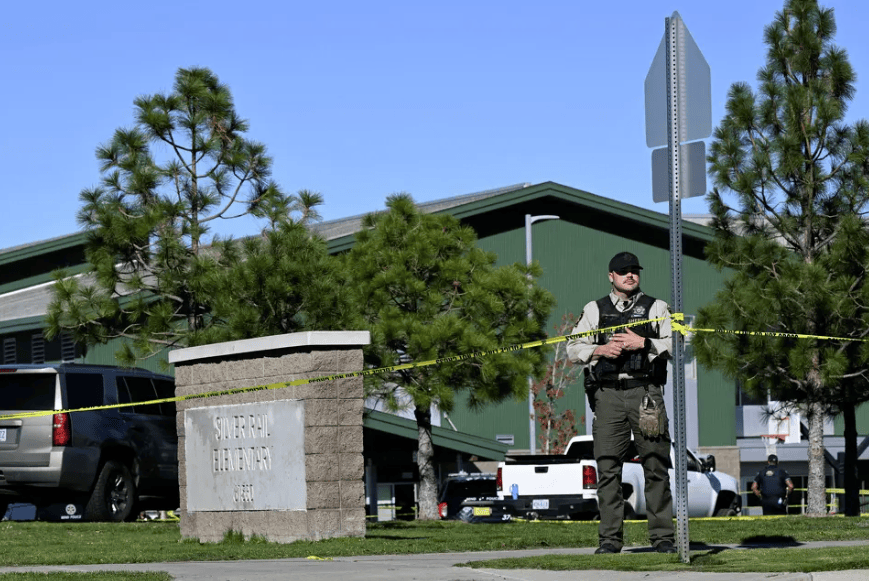
On October 15, 2026, three boys—five-year-old Rhoam Summer and two children ages eight and eleven whose families have requested privacy—and 25-year-old teacher Megan Lambert were murdered inside Silver Rail Elementary School in Bend, Oregon. Seven-year-old Saylor Graham and educational assistant Becky Drury were seriously injured. Other children and educators survived, including a teacher who fought the gunman. The attacker was sixteen years old, a former student carrying a shotgun reportedly given to him by his mother for his birthday. An armed father ultimately stopped him. Now, as families mourn and survivors recover, investigators are trying to piece together what happened in the hours, weeks and months before the attack—and whether anyone had an opportunity to prevent it.
By Wait, Explain That? | October 19, 2026
Rhoam Summer had already decided what he wanted to be for Halloween.
A bunny.
It was October, and the five-year-old had the kinds of plans children make without ever considering that they might not get to see them through. He wanted to visit a pumpkin patch, learn to ride horses and play an instrument. He loved rainbows, unicorns, sharks and dinosaurs. He loved to draw and paint, filling his world with creatures and stories that existed because he imagined them.
His parents, Kelik and Lillian Summer, described a little boy who could find something wonderful in almost anything, even creatures other people might find frightening.
There should have been years of Halloween costumes ahead of him. Years of drawings covering the refrigerator, of discovering new favorite animals, of changing his mind about what he wanted to be when he grew up.
Instead, on October 15, Rhoam went to Silver Rail Elementary School and never came home.
Neither did two other boys, ages eight and eleven. Their families have chosen not to release their names publicly, and that privacy deserves to be respected. We may not know their favorite animals, what they wanted to be for Halloween or what they dreamed of becoming someday, but their stories matter every bit as much. They were children whose families expected to see them come home that afternoon.
Twenty-five-year-old Megan Lambert never came home, either.
Megan had grown up in Bend. She graduated from Mountain View High School in 2019, went on to Boise State University and spent time studying abroad in Barcelona. After working as a substitute teacher at Silver Rail, she finally secured her first full-time teaching position.
Her family said it was her dream job.
She coached volleyball as well, and during her first season, she declined her coaching pay so children whose families couldn’t afford to participate would still have the opportunity to play.
Megan was just beginning her career, and she was already making decisions that put other people’s children first. Her family described her as compassionate, funny, opinionated and someone who stood up for children with special needs.
Seven-year-old Saylor Graham and educational assistant Becky Drury survived the attack with serious injuries. Another child and adult escaped the classroom without physical injuries, and a surviving teacher fought the gunman in an effort to stop the violence.
Four people were murdered. Others were wounded. Every person inside that classroom was affected by what happened.
And the person responsible was sixteen years old.
A teenager who had once attended the very school he attacked.
The more investigators revealed about what happened inside Silver Rail, the more one question demanded attention: What happened before he got there?
The first indication that something was terribly wrong came from outside the school.
It was shortly before 1 p.m. when a teenager approached Silver Rail carrying a shotgun. According to Bend Police, he threw the weapon over the perimeter fence, climbed onto school property and continued toward the building.
A man driving a red Toyota pickup truck saw him and confronted him.
The teenager fired at the truck, striking it at least three times. The driver escaped and called 911. Dispatchers received that call at approximately 12:59 p.m.
Another driver had witnessed what was happening.
Kaylub Giamanco was thirty-six years old, and his two daughters attended Silver Rail. He turned into the school parking lot as the teenager moved toward the entrance.
The exterior doors were locked.
But the teenager had a shotgun.
He fired through the glass, forced his way into the building and entered a classroom immediately to the left of the entrance.
Five children and four adults were inside.
It was a special education classroom.
The gunman opened fire.
Rhoam Summer was killed. So were the other two boys and Megan Lambert. Seven-year-old Saylor Graham and educational assistant Becky Drury were seriously wounded. Another child and adult escaped without physical injuries.
Investigators later determined that the attacker fired as many as fifteen shotgun rounds. He had approximately forty-four additional rounds of ammunition remaining.
We do not know everything that happened inside that room, and the people who survived should not have to relive those moments publicly to satisfy anyone’s curiosity.
But police have described one extraordinary act of resistance.
A surviving teacher threw her cellphone at the gunman, tackled him and struggled to take away his shotgun.
She was fighting an armed attacker who had already opened fire on the people around her.
Outside, Giamanco had retrieved his legally owned .40-caliber handgun from his vehicle. He entered the school and moved toward the sound of gunfire.
When he reached the classroom, he encountered the teacher struggling with the attacker.
Giamanco fired, fatally wounding the teenager.
The shooting stopped.
Police officers arrived at approximately 1:02 p.m.
Only minutes had passed since the first emergency call.
Four people were dead, two others were seriously wounded, and an entire school community was left facing something no family should have to experience.
We cannot know how many more people might have been harmed if the teacher had not fought back or if Giamanco had not entered the school. But their actions are central to understanding how the attack ended.
Megan Lambert’s family later thanked Giamanco publicly, calling him a hero. His family has acknowledged the emotional toll of what happened and requested privacy.
Giamanco entered the building knowing his daughters were somewhere inside. He was not a police officer responding to a call. He was a father who had witnessed an armed teenager approaching his children’s school and made the decision to intervene.
His actions deserve recognition, just as the surviving teacher’s courage deserves recognition.
The fact that Giamanco used a firearm to stop the attack is important. So is the fact that the attacker used a firearm to murder four innocent people. Neither changes what happened to the other.
But recognizing how the attack ended brings us to the question that investigators are still trying to answer.
Could anything have stopped it from beginning?
Four days after the shooting, on October 19, Bend Police asked the public for help.
Investigators wanted residents and businesses to review surveillance footage from the morning of October 15, specifically between 10 a.m. and 1 p.m.
They were looking for video of Griffin J. John II, the sixteen-year-old attacker, moving through the area between Third Street and Brosterhous Road, including the streets surrounding Silver Rail.
Police believed he had traveled to the school on foot. They described him as approximately six feet tall and 140 pounds, wearing black pants, a black T-shirt and a black backpack.
By then, investigators had reconstructed much of what happened inside Silver Rail. They knew when the first emergency call came in, how Griffin entered the building and how the attack ended.
But they were still trying to establish his movements before he arrived.
Where had he been that morning? When did he obtain the shotgun and ammunition? Had he already decided where he was going? Had he communicated with anyone?
The request for footage does not mean police believe another person was involved. It means they are still gathering evidence about what Griffin did before reaching the school.
Investigators have also been examining his electronic devices, search history, social media and other digital activity. As of October 19, they have not publicly established a motive or confirmed that Griffin communicated a specific threat before the attack.
And then came another piece of reporting that raised difficult questions about how he obtained the weapon.
CBS News reported that Griffin’s mother, Shauntai Nickerson, legally purchased a Maverick 88 pump-action 12-gauge shotgun in August 2026.
According to law enforcement sources cited by CBS, she gave the shotgun to her son as a birthday gift for recreational use.
Griffin turned sixteen that August.
Less than two months later, he carried a shotgun into his former elementary school and murdered four people.
The reported gift raises questions, but it is important to distinguish what has been reported from what investigators have established.
For many families, teaching teenagers to hunt or safely handle firearms is a normal part of growing up. A shotgun given to a minor is not automatically an illegal transfer under Oregon law, nor does the gift itself establish that a parent knew the child posed a danger.
Oregon’s firearm statutes contain specific rules about transfers involving minors, supervision and safe storage. ORS 166.403 generally requires supervision in certain transfers to minors but also contains exceptions, including for some lawful transfers of non-handgun firearms when the minor becomes the owner. ORS 166.395 separately addresses firearm storage.
Those distinctions matter because investigators must establish the actual circumstances of the reported gift before determining whether any law was violated.
Did Griffin own the shotgun after his birthday, or was he permitted to use it? Where was it kept? Who controlled access to it? How did he obtain the ammunition? And did anyone have information suggesting that allowing him access posed a danger?
Nickerson has expressed grief over her son’s actions and indicated that she would have acted to prevent the shooting if she had known what he intended to do. There is no publicly established evidence that she knew of his plans.
That does not end the inquiry into the firearm. It simply means the answers must come from evidence rather than assumptions about what a parent should have known.
Research suggests that firearm access is an important part of understanding school violence. Studies of school-associated violent deaths have identified homes, friends and relatives as significant sources of firearms used by young perpetrators.
The Centers for Disease Control and Prevention found that firearms were involved in approximately 95% of multiple-victim school-associated youth homicides between 1994 and 2018.
A weapon used in school violence does not necessarily begin with an illegal purchase. It may have been purchased lawfully and later accessed by someone who used it to commit a crime.
That distinction matters because the reported purchase in August may be only the beginning of the shotgun’s story.
Investigators still need to establish what happened afterward.
And the weapon is not the only part of Griffin’s history that remains unexplained.
Griffin had attended Silver Rail Elementary when he was younger.
He later attended other schools in the Bend-La Pine district and was last enrolled there in November 2025, according to district information reported by Oregon Public Broadcasting.
By October 15, he was no longer a student at Silver Rail.
Yet that was where he returned.
Investigators have not publicly explained why Griffin chose his former elementary school, why he entered that particular classroom or whether he knew any of the people inside.
Griffin previously received special education services. During the pandemic, his mother spoke publicly about difficulties he experienced with remote learning and her desire for him to receive in-person support.
Because the attack occurred in a special education classroom, some have questioned whether his educational history played a role.
It is a question investigators may examine, but the connection has not been established.
Receiving special education services is not evidence of dangerousness. There is no verified finding that Griffin’s disability or educational needs caused the attack.
What matters is whether investigators can establish a specific grievance, threat, plan or other evidence explaining his decisions.
The U.S. Secret Service has spent years examining how targeted school violence develops. In its 2019 study Protecting America’s Schools, researchers reviewed forty-one attacks between 2008 and 2017 and found that many attackers had displayed concerning behaviors or communicated information about their intentions before the violence occurred.
In some cases, other people noticed those behaviors, but the information never reached someone who could evaluate the threat.
That does not mean every attack can be predicted.
It means understanding what people knew before an attack can be just as important as reconstructing what happened during it.
A parent may observe something a teacher does not know about. A classmate may receive a message that never reaches a school administrator. Law enforcement may have information unavailable to a family.
Did anyone know Griffin was angry with the school? Had he made threats? Had he shown signs of planning violence? Did his family, former teachers or classmates have information that might have prompted concern?
As of October 19, investigators have not publicly established that any such warning existed.
A law enforcement official also told Oregon Public Broadcasting that Griffin had no known prior juvenile criminal history.
That does not prove there were no concerning behaviors. But it also gives us no basis to claim someone ignored them.
And understanding Griffin’s history must never be confused with excusing his actions.
He was sixteen years old when he carried a shotgun onto school property, forced his way inside and murdered three children and a teacher.
Whatever investigators eventually learn about his experiences, he remains responsible for what he did.
The question is whether anything in the period leading up to October 15 offered someone a reasonable opportunity to stop him.
Because once he arrived at Silver Rail, there was very little time.
The school’s exterior doors were locked when Griffin approached.
The Bend-La Pine School District has described a range of safety measures at its schools, including cameras, fencing, controlled entrances and emergency procedures.
But Griffin fired through the glass and entered the building.
The first 911 call came at approximately 12:59 p.m. Law enforcement was alerted at 1:00 p.m. At approximately 1:01 p.m., responding officers directed the school to lock down.
The first officers arrived at approximately 1:02 p.m.
That timeline is extraordinarily short, but it leaves important questions about what happened inside the school during those minutes.
When did staff first become aware of the threat? When did individual classrooms receive the lockdown warning? Were procedures followed as designed? And could any security measure reasonably have delayed Griffin long enough to change what happened?
A locked door is not necessarily designed to withstand gunfire. A lockdown procedure cannot guarantee that every classroom will be secured before an attacker reaches it.
Those limitations do not establish negligence. They do, however, deserve examination when four people have been murdered inside a school.
Rhoam’s parents are pursuing that examination.
Kelik and Lillian Summer have retained attorneys to investigate the circumstances surrounding their son’s death. According to the Associated Press, their inquiry includes the school’s active-shooter procedures and how Griffin obtained the shotgun.
Their attorneys have also raised questions about the original firearm purchase and transfer.
The family’s investigation is not proof that the school district, firearm dealer or anyone else acted unlawfully. It is an effort to establish whether any preventable failure contributed to the attack.
And it brings us to the question that runs through this entire story.
Who failed Griffin? Who failed Rhoam, the other two boys and Megan?
The word failed carries a serious implication. It suggests that someone had a responsibility, an opportunity to act and did not do what was reasonably required.
We have not established that here.
If investigators find that credible warnings were ignored, firearm laws were violated or reasonable safety procedures were not followed, those findings will matter. If they determine that no recognizable warning existed and that reasonable precautions were taken, that will matter too.
What we cannot do is decide the answer before the evidence is available.
We also cannot pretend that any one measure offers a guarantee against every act of violence.
The CDC’s research shows that school-associated homicides account for a small proportion of youth homicides overall, even as multiple-victim attacks remain a serious concern. RAND’s reviews have found supportive evidence that certain child-access prevention laws reduce firearm injuries and deaths among young people, although the evidence concerning their effect on mass shootings specifically remains inconclusive.
The Secret Service’s work emphasizes recognizing and evaluating credible threats. School security can delay or deter unauthorized entry. And the actions of Giamanco and the surviving teacher demonstrate how intervention can stop violence that has already begun.
Those are different opportunities to prevent or limit harm. Each has limitations.
Understanding which opportunities existed at Silver Rail requires knowing far more than we know today.
It requires the results of the police investigation, the firearm records, the school’s emergency response records and whatever evidence investigators uncover about Griffin’s behavior and intentions.
Only then can we begin to answer whether someone failed to act—or whether this attack occurred despite reasonable precautions.
While those questions remain unanswered, the families and survivors are living with what happened.
Seven-year-old Saylor Graham survived with serious injuries. Educational assistant Becky Drury was also wounded. Other children and adults escaped the classroom, including the teacher who physically fought the gunman.
Kaylub Giamanco survived after stopping the attacker. His family has acknowledged the emotional weight of what happened and requested privacy.
Throughout Silver Rail, parents waited for news as children were evacuated and families were reunited.
Some parents got to hold their children again.
Others did not.
Megan Lambert’s family has established the Megan Lambert Memorial Fund through the Oregon Community Foundation. It will support causes reflecting her values, including education, mental-health services, children with special needs and opportunities for young people.
It is a fitting way to remember a teacher who gave up her volleyball coaching pay so children who otherwise might have been left out could participate.
And Rhoam’s parents have made a request of their own.
They want people to create art in their son’s memory.
Draw a shark, a dinosaur or a monster. Make something.
It is a request that reflects the little boy they knew, not the terrible way his life ended.
Rhoam loved making things. He loved imagining stories and finding joy in creatures that fascinated him.
He was five years old.
He wanted to dress up as a bunny for Halloween.
We will continue following the investigation into Griffin’s motive, his movements before the attack, his access to the shotgun and whether anyone had a reasonable opportunity to intervene.
Those answers matter.
But they matter because of the people whose lives were taken and the families who have to live without them.
Three boys and a young teacher went to school on October 15 and never came home.
The two boys whose families have chosen privacy deserve to be remembered with the same dignity as those whose stories have been shared publicly. Megan deserves to be remembered for the young people she helped. Saylor, Becky and the other survivors deserve care, privacy and lives that are not defined by what happened to them.
And Rhoam deserves to be remembered for the little boy who loved sharks, dinosaurs, rainbows and unicorns.
Not just for the way he died.
For the life he was living.
And for the Halloween when he was supposed to be a bunny.
Wait, Explain That?
The story everyone knows is where we start. The question nobody asked is where we go.
Reporting note: This article reflects publicly available reporting through October 19, 2026. Investigators have not announced a motive. The reported birthday gift is attributed to law enforcement sources cited by CBS News. No finding of criminal wrongdoing or negligence by the gunman’s mother, school officials or a firearm dealer has been established. The families of the eight- and eleven-year-old victims have requested privacy.
Sources & References
Official investigation
- Bend Police Department. Silver Rail Elementary School Shooting — Official News Releases, October 15–19, 2026.
https://www.flashalertbend.net/news-releases.html
Victims, survivors and eyewitness accounts
2. Associated Press. Parents of Bend School Shooting Victim Hire Attorneys to Investigate School Plans and Gun Purchase. October 19, 2026.
https://apnews.com/article/ab538a031f067a99c54d60c4da76b036
- Oregon Public Broadcasting. Bend Police Now Say an Additional Student and Adult Escaped Silver Rail Shooting Unharmed. October 19, 2026.
https://www.opb.org/article/2026/10/19/bend-police-now-say-an-additional-student-and-adult-escaped-silver-rail-shooting-unharmed/ - KATU. Motive Remains Unclear Days After Deadly Shooting at Silver Rail Elementary School. October 18, 2026.
https://katu.com/news/local/motive-remains-unclear-days-after-deadly-shooting-at-silver-rail-elementary-school
The suspect and firearm investigation
5. CBS News. Gun Used in Oregon Elementary School Shooting Was Birthday Gift From Shooter’s Mom, Sources Say. Updated October 19, 2026.
https://www.cbsnews.com/news/bend-oregon-elementary-school-shooting-gun-birthday-gift-mom/
- Oregon Public Broadcasting. Questions About Motive Remain After Bend School Shooting. October 17, 2026.
https://www.opb.org/article/2026/10/17/questions-about-motive-remain-after-bend-school-shooting/
Firearm laws and school violence research
7. Oregon Legislature. Oregon Revised Statutes, Chapter 166 — Offenses Against Public Order; Firearms and Other Weapons.
https://www.oregonlegislature.gov/bills_laws/ors/ors166.html
- U.S. Secret Service, National Threat Assessment Center. Protecting America’s Schools: A U.S. Secret Service Analysis of Targeted School Violence. 2019.
https://www.secretservice.gov/sites/default/files/2020-04/Protecting_Americas_Schools.pdf - Centers for Disease Control and Prevention. School-Associated Violent Death Surveillance System.
https://www.cdc.gov/youth-violence/data-research/school-associatedviolentdeathstudy/index.html - RAND Corporation. Gun Policy in America — Research and Evidence Reviews.
https://www.rand.org/research/gun-policy.html
Additional Sources — Victim Tributes and Family Statements
11. Oregon Public Broadcasting — Rhoam Summer’s Family Statement
Courtney Sherwood. Parents of Rhoam Summer Share Memories of 5-Year-Old Killed in Bend Shooting. October 19, 2026.
Includes Rhoam’s plans to dress as a bunny for Halloween, his love of rainbows, unicorns, sharks and dinosaurs, and his parents’ request that people create artwork in his memory.
12. Associated Press — Megan Lambert’s Life and Volleyball Coaching
As an Oregon Community Mourns 4 Killed in School Shooting, 2 Wounded Survivors Remain Hospitalized. October 17, 2026.
Confirms that Megan coached with Central Oregon Volleyball Club. Club director Heidi Wood said Megan declined her first season’s coaching pay so the money could fund scholarships for children whose families couldn’t afford to participate. Also identifies injured survivors Saylor Graham and Becky Drury.
https://apnews.com/article/5cee41bcfd4264abab905b2b29991e99
13. Oregon Community Foundation — Megan Lambert Memorial Fund
Oregon Community Foundation Shares Ways to Support Bend Community After Silver Rail Elementary School Shooting. October 2026.
Confirms that Megan’s family established a memorial fund to support education, mental health, services for children with special needs, Oregon schools and potentially youth volleyball programs in Central Oregon.
14. The Guardian — Megan Lambert’s Family Tribute
Oregon Shooting Victims: Three Boys and Female Teacher Killed at Elementary School. October 16, 2026.
Includes her family’s description of teaching at Silver Rail as her dream job, her dedication to children and her decision to waive coaching compensation.
https://www.theguardian.com/us-news/2026/oct/16/bend-oregon-shooting-victims



Leave a Reply