
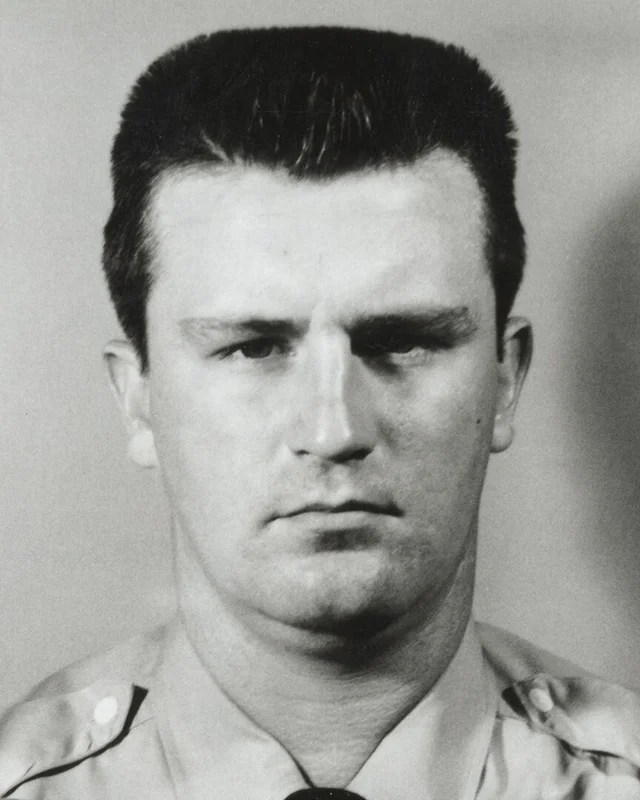
He was a Chicago police officer when eight-year-old Gloria Kowalewicz was murdered. He later became a detective, investigated homicides and sexual offenses, collected professional honors, and retired twice. Sixty-six years after Gloria’s death, forensic evidence identified him as her killer. Now the question is what happened during all the years in between.
By Wait, Explain That? | October 14, 2026
A Life That Looked Very Different on Paper
On September 6, 2006, the Chicago Tribune published an obituary for Thomas Francis McInerney Jr.
It described the life of a 70-year-old man who had died in Las Vegas one week earlier.
An Army veteran. A retired Chicago homicide detective. A federal criminal-defense investigator. A husband, father, stepfather, and grandfather.
He had served 28 years with the Chicago Police Department, received numerous commendations, and earned recognition as an Outstanding Federal Defender Investigator in 2003.
He had retired twice.
To anyone reading that obituary in 2006, it was the account of a long career in public service and criminal investigations.
There was something the obituary didn’t say.
And something the people writing it had no publicly established reason to know.
Four decades earlier, on November 12, 1960, eight-year-old Gloria Kowalewicz had been abducted while walking to church on Chicago’s Southwest Side.
Hours later, her body was discovered in a wooded ravine near Palos Park. She had been shot twice in the head.
The murder remained unsolved.
Until October 2026.
That’s when Chicago police publicly revealed that DNA recovered from Gloria’s clothing and a fingerprint preserved on her Communion purse had identified Thomas Francis McInerney Jr.
The retired detective.
The man with the commendations.
The man whose professional life had been spent investigating other people’s crimes.
And suddenly, that 2006 obituary read very differently.
Who Was Thomas McInerney Before Gloria?
McInerney was born in Chicago on November 15, 1935.
His parents were Thomas F. McInerney Sr. and Winifred Norton McInerney.
According to 1950 Census records examined by the Chicago Tribune, his parents lived at 6557 South Laflin Street.
That address was approximately three-quarters of a mile from Gloria Kowalewicz’s childhood home.
His father worked as a guard at the Chicago House of Correction.
The proximity matters because investigators say they have found no evidence that Gloria and McInerney knew each other before her murder.
But it raises a reasonable question about his familiarity with the neighborhood where she lived.
Did he know those streets well? Had he continued living nearby as an adult? Did he regularly visit his parents?
We don’t have documented answers.
His parents’ 1950 address cannot establish his residence on November 12, 1960.
What we do know is that McInerney later served in the United States Army as a paratrooper in the Rangers.
In 1959, he joined the Chicago Police Department.
The following year, Gloria was murdered.
McInerney was 24 years old.
Just three days short of his 25th birthday.
And already wearing a police badge.
November 12, 1960: Where Was Officer McInerney?
This is one of the first questions we believe deserves a documented answer.
Where was Thomas McInerney when Gloria disappeared?
Was he on duty?
Off duty?
Assigned to patrol?
Working a shift that put him near her neighborhood?
Or somewhere else entirely?
Public reporting establishes that McInerney had joined CPD in 1959 and initially worked as a patrol officer on Chicago’s West Side.
It does not establish his exact assignment, schedule, or whereabouts on the morning Gloria was abducted.
And that matters.
Investigators ultimately identified him through forensic evidence. His precise whereabouts that morning would help explain how the crime occurred.
The public also does not know whether McInerney ever participated in the original investigation or appeared among the officers who escorted Gloria’s funeral.
There is no evidence he did either.
Those questions remain unanswered.
But they are not unreasonable questions to ask about a man police have now identified as her killer.
Four Years Later, He Became a Detective
In 1964, McInerney became a Chicago police detective.
His assignments over the years included burglary, vice, gangs, homicide, sexual offenses, and violent crimes.
Pause on that for a moment.
Investigators have now concluded that McInerney was responsible for the killing of an eight-year-old child in 1960.
And years later, he was investigating homicides and sex crimes.
That is not evidence he committed additional offenses.
But it is an extraordinary contradiction.
A detective investigating a sexual offense might review witness statements, interview victims, examine suspect histories, and work with forensic findings.
A homicide detective might handle evidence, question witnesses, investigate suspects, and help determine what happened during someone’s final hours.
These are enormous responsibilities.
Responsibilities requiring integrity, sound judgment, and public trust.
McInerney held positions involving those responsibilities while his own involvement in Gloria’s murder remained undiscovered.
There is no public evidence that he tampered with another investigation or used his position to conceal another crime.
But his career raises an important question about institutional accountability:
What happens when someone entrusted with investigating serious crimes is later identified through forensic evidence in a serious crime of his own?
How should authorities review that person’s work?
And which records should the public be allowed to examine?
The Career That Kept Moving Forward
By the time McInerney retired from Chicago police in 1987, he had served 28 years.
His obituary says he received numerous commendations during that career.
But commendations tell only part of a professional history.
What about complaints?
Internal investigations?
Disciplinary findings?
Transfers?
Supervisory evaluations?
We have not located his complete CPD personnel or disciplinary file.
And that means we cannot say whether McInerney had a spotless record or a documented history of misconduct.
An obituary does not answer either question.
Nor does the absence of a publicly reported disciplinary offense establish that none occurred.
For WET, this is one of the most important pieces of missing information.
We know what his obituary celebrated.
We do not yet know what his complete employment file contains.
Then Came Nevada
In 1987, McInerney left the Chicago Police Department.
He subsequently worked as an investigator for federal public defender offices in Reno and Las Vegas, Nevada.
This was not a continuation of police employment.
Federal public defender investigators work on behalf of criminal-defense teams, helping attorneys examine evidence, locate and interview witnesses, and investigate facts relevant to their clients’ cases.
McInerney continued in that line of work until 2004.
In 2003, he was honored as an Outstanding Federal Defender Investigator.
That recognition appeared in the obituary published after his death.
But his move west leaves gaps in the public record.
Which years did he work in Reno?
Which years did he work in Las Vegas?
Where did he live during those periods?
What cases was he assigned?
And have law-enforcement agencies in either city considered whether preserved evidence from unresolved crimes warrants comparison with the DNA that identified him in Gloria’s murder?
There is no publicly established additional DNA match.
Nor is there evidence that an unsolved Nevada homicide has been attributed to him.
Working in Nevada does not make him a suspect in every unsolved crime committed there.
But a dated record of his movements and work assignments would help investigators evaluate potential leads rather than rely on speculation.
The Family Life Described After His Death
McInerney died in Las Vegas on August 30, 2006.
His obituary listed his wife, Kathy Atkinson-McInerney, five children, a stepson, and grandchildren.
Condolence messages recalled a man who told stories, made people laugh, and maintained friendships with former law-enforcement acquaintances.
Those recollections are part of the public record.
They reveal how some people remembered him.
They do not tell us what his family knew or suspected about his earlier life.
And there is no evidence that his wife, children, or grandchildren had any knowledge of Gloria’s murder.
Their names and private lives are not the focus of this investigation.
The relevant point is the contrast between the public record of McInerney’s life and the evidence that emerged twenty years after his death.
In 2006, his obituary celebrated decades of investigative work.
In 2026, investigators announced that evidence from a murdered child’s clothing and purse identified him as her killer.
Both records now form part of his history.
The Fingerprint That Changes Everything
Among the most consequential details in Gloria’s case is a fingerprint recovered from the strap of her white Communion purse.
Police preserved that fingerprint in 1960.
McInerney had submitted his own fingerprints when he joined the Chicago Police Department in 1959.
After genetic evidence identified him in 2026, investigators retrieved his employment application and compared the prints.
They matched.
The DNA identification and fingerprint evidence led Chicago police to conclude that McInerney killed Gloria.
That leaves a question with implications far beyond this single case.
Was his fingerprint ever compared against the evidence before 2026?
If not, why not?
Were records inaccessible?
Was the fingerprint unsuitable for earlier comparison methods?
Were investigators following other leads?
Was his status as a police officer ever considered relevant?
We cannot answer those questions from the public reporting currently available.
And we should not assume that investigators overlooked an obvious match without understanding the technology, record systems, and investigative decisions involved.
But this question deserves more than silence.
Because Gloria’s fingerprint evidence was preserved for decades.
And the records that finally helped identify her killer originated within the department where he worked.
Could There Have Been Other Victims?
This is the question that will inevitably follow the identification of McInerney.
Was Gloria the only person he killed?
The answer is that we do not know.
His confirmed forensic connection to Gloria’s murder does not establish another offense.
It also does not allow investigators to rule out the possibility of other crimes without examining relevant evidence.
According to the Chicago Tribune, police said McInerney was not currently suspected in other crimes at the time of the announcement.
The FBI was nonetheless pursuing additional investigative leads.
Those two statements are not contradictory.
Authorities may examine possibilities without having evidence sufficient to name someone as a suspect in another case.
There is one particularly important forensic reason to ask whether historical evidence has been reviewed.
In 2010, investigators developed a male DNA profile from semen recovered from Gloria’s dress.
In July 2026, that profile was attributed to McInerney.
If another investigation contains suitable, preserved unidentified-offender DNA, an authorized forensic comparison could potentially establish or exclude a connection.
That is a scientific question.
It cannot be answered by photographs, police sketches, geographic coincidences, or assumptions about how offenders behave.
Nor can we conclude that McInerney was a serial killer because Gloria’s murder was brutal.
Police have not publicly identified another victim.
We are not suggesting that they have.
But as investigators examine what remains unresolved, the existence of preserved biological evidence in historical cases becomes a legitimate subject for scrutiny.
Not every unanswered murder is connected. But every proposed connection should be tested against evidence—not instinct.
There’s Another Kind of Case Review That Matters
When police and prosecutors discuss McInerney’s work history, two separate questions arise.
The first is whether he committed crimes beyond Gloria’s murder.
That would require evidence linking him to those offenses.
The second is whether cases he investigated should be examined for issues affecting their integrity.
That is a different question entirely.
He worked on homicide, sexual-offense, and other violent-crime investigations.
What if a case depended heavily on his interviews, observations, or credibility?
What if he played a significant role in collecting or interpreting evidence?
The fact that he was later identified in Gloria’s murder does not automatically invalidate his police work.
But knowing what authorities now know, it is reasonable to examine his role in cases where his conduct or credibility could have mattered.
The Cook County State’s Attorney’s Office has begun identifying cases McInerney may have handled.
We need to know what that process involves.
Will the review include cases that resulted in convictions?
Will prosecutors examine whether his involvement was material to the outcome?
Will the findings be made public?
And will people affected by those cases be informed if something significant emerges?
These are questions about transparency and accountability.
Not allegations that McInerney fabricated evidence or wrongfully convicted anyone.
There is no public evidence establishing that he did.
The Questions Authorities Still Haven’t Answered
Nearly 66 years after Gloria’s murder, investigators have identified the man they say was responsible.
But the public record of that man’s life remains incomplete.
Here are the questions we believe deserve answers.
Where was McInerney on November 12, 1960?
What shift was he scheduled to work, and can his whereabouts be reconstructed?
Did investigators ever compare his fingerprints with Gloria’s evidence before 2026?
If not, what prevented the comparison?
What do his personnel and disciplinary records contain?
Were there complaints or significant incidents during his 28 years with Chicago police?
Which criminal investigations did he personally handle?
And which of those cases, if any, might warrant review today?
What was his exact employment and residence timeline in Nevada?
Which years belonged to Reno, and which to Las Vegas?
Have investigators compared his identified DNA with eligible evidence from other unresolved cases?
Have any comparisons excluded him? Have any produced investigative leads?
Those questions are specific.
They are answerable, at least in principle, through records, official explanations, and forensic work.
And they are more useful than simply asking strangers on the internet whether McInerney looks like an old police sketch.
The Question Behind the Headline
When the news broke that a retired Chicago detective had been identified as the killer of eight-year-old Gloria Kowalewicz, the revelation was almost impossible to ignore.
A police officer.
A murdered child.
A fingerprint that had survived for more than six decades.
A man who lived out his life without facing trial.
But the biggest unanswered question may not be whether Thomas McInerney committed another murder.
It may be how much of his life inside the criminal justice system remains unexplained.
What did his colleagues know about him?
What do his employment records reveal?
What can his assignments tell us about the cases he handled?
And what opportunities existed to identify him before he died?
There is a difference between being suspicious of someone and having evidence against them.
Gloria’s case now has evidence.
The other questions require answers.
For the people who loved her, the identification came far too late.
Her father died in 1978.
Her mother died in 2000.
Neither learned who killed their daughter.
Her younger brother, Adam, finally received that answer in 2026.
And that is why any investigation into McInerney’s life needs to begin and end with Gloria.
Not because his career is more important than her story.
But because the truth about his career might help explain how her killer went unidentified for so long.
And because the public deserves to know what happened after a police officer murdered a child and continued working in positions of trust for decades.
Thomas McInerney’s obituary told the story of the life he lived.
Gloria Kowalewicz’s evidence told the story it left out.
Now investigators must determine whether there is anything else the public needs to know.
Wait, Explain That? investigates overlooked evidence, criminal investigations, and the questions that remain after the headlines fade.
For the full story of Gloria Kowalewicz, her final morning, and the evidence that identified her killer, read our investigation: She Was Eight Years Old. Her Killer Wore a Badge.
Reporting and source note
This article is based on reporting from the Chicago Tribune, Associated Press, publicly available statements from Chicago police, and McInerney’s September 6, 2006 obituary. WET has not independently obtained his complete personnel file, disciplinary records, federal defender assignments, or original investigative records. No additional victim or forensic connection to another crime has been publicly established as of October 14, 2026.
Sources:
- Chicago Tribune: https://www.arcamax.com/currentnews/newsheadlines/s-4319650
- Associated Press: https://apnews.com/article/8566bdef2660bad4a0033129a0181afc
- Original 2006 obituary: https://www.legacy.com/us/obituaries/chicagotribune/name/thomas-mcinerney-obituary?id=2466817


Leave a Reply