
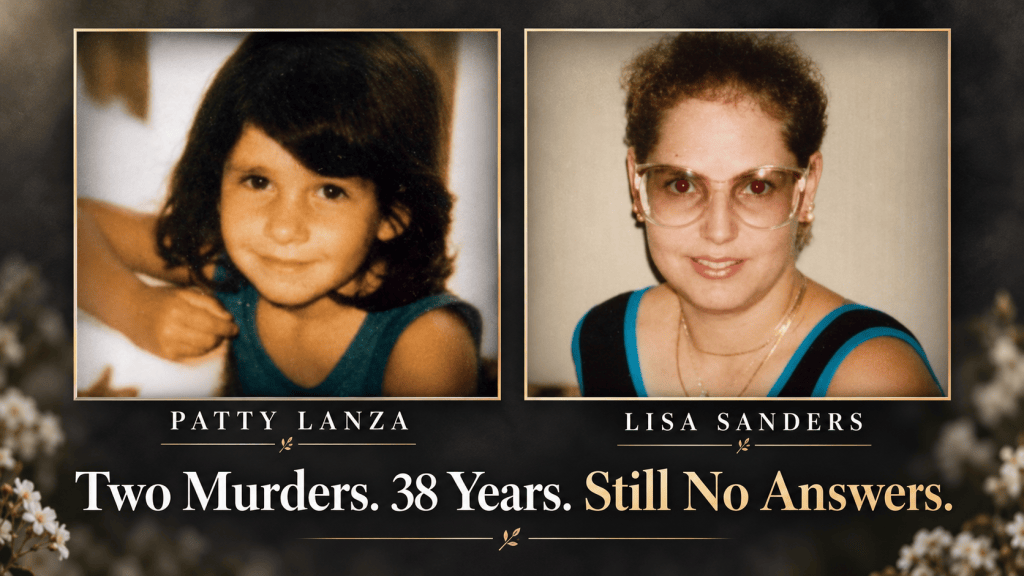
In 1988, a four-year-old girl and a 20-year-old leukemia survivor were murdered in the Florida Keys, five months apart. Their deaths became entangled in rumors of satanic cults, serial killers and ritual sacrifice. Decades later, the theories are better remembered than the victims—and neither murder has a publicly established resolution.
On December 16, 1988, Lisa Sanders spent the day Christmas shopping with her mother.
They had plans for the next morning, too. They were supposed to meet at six o’clock to sell Christmas decorations at a flea market.
Before they parted, Lisa’s mother reminded her about their plans.
Lisa assured her she’d be there.
She had every reason to expect another ordinary Saturday.
At nine years old, Lisa had been diagnosed with acute leukemia. For years, her childhood was consumed by hospital stays, chemotherapy, painful treatments, and the uncertainty of whether she would survive.
But she did.
By 18, her leukemia was in remission, and she had graduated with her high school class. At 20, she moved from Michigan to the Florida Keys to begin a new chapter of her life.
She wanted to become a nurse. After everything she’d been through, she wanted to help other people.
That Friday evening, Lisa went to a party on No Name Key, a quiet island in the Lower Florida Keys.
A couple of hours later, she wanted to leave.
The people she’d arrived with weren’t ready.
So Lisa started walking home alone.
She never made it.
The next day, a sheriff’s deputy discovered her body near a deserted road.
Lisa had been brutally murdered.
But she wasn’t the first.
Five months earlier, four-year-old Patricia “Patty” Lanza disappeared from a crowded party on nearby Little Torch Key.
Her body was found the following afternoon.
Patty had been sexually assaulted and killed.
Two victims. Two parties. Two small islands separated by only a few miles.
And two families who would spend years waiting for answers.
Their murders eventually became part of a much larger mystery involving rumors of satanic cults, missing organs, and speculation about a serial killer operating in the Florida Keys.
But the theories became so much bigger than the people at the center of the story.
And that’s what brought us back to these cases.
Not to tell another story about satanic rituals.
To ask a question that should have been answered decades ago.
Who killed Patty Lanza and Lisa Sanders?
And with everything investigators know today, are we any closer to finding out?
Patty was only four years old
On July 2, 1988, Patty Lanza attended a party on Little Torch Key with her mother, Deborah.
It was a crowded gathering, with people coming and going. Alcohol was involved, and at least one attendee later described possible drug use.
Patty was wearing a white jumpsuit.
Her mother last remembered seeing her around ten o’clock that night.
Then Patty was gone.
By the following afternoon, the little girl’s body had been discovered nearby. Her jumpsuit and underwear were found in the woods not far from where she was recovered.
An autopsy established that Patty had been sexually assaulted and suffered a fatal head injury.
She was four years old.
At an age when most children are learning to read, making friends, and figuring out which shoes belong on which feet, Patty’s life was taken from her.
Someone at that gathering may have seen something that mattered.
Investigators questioned people who attended, including a man who acknowledged being with Patty that night.
He maintained that Patty was alive when he last saw her.
Authorities arrested him on a false-imprisonment charge, but the charge was eventually dropped because investigators lacked sufficient evidence.
The man died the following year.
Years later, DNA testing excluded him from biological evidence examined in the case, according to the Monroe County Sheriff’s Office’s account of the investigation.
And that leaves an important question.
If investigators ruled out one of the people they initially focused on, where did the investigation go next?
We still don’t have a complete public accounting of what biological evidence was tested, what type of DNA analysis was used, or whether other potential suspects were compared against that evidence.
An exclusion can eliminate a lead. It doesn’t identify the killer.
And Patty’s family was still left without the answer that mattered most.
Who took her child away from that party, and who killed her?
The families were connected before the murders
Five months later, Lisa Sanders was murdered.
And investigators were confronted with a detail that seemed almost impossible to ignore.
Patty’s grandparents, Alice and her husband Glendenning, lived next door to Lisa’s parents.
The families’ connection existed before Lisa died, before the rumors about satanic rituals, and before a third murder intensified fear across the Lower Keys.
But what did it mean?
The murders occurred within months of each other and only a few miles apart.
Both victims had attended parties before they were killed.
And both families were connected by the same small community.
That was enough to make people wonder whether they were looking at the same killer.
But there were significant differences.
Patty was a four-year-old child who had been sexually assaulted and suffered fatal blunt-force injuries.
Lisa was a young adult who was beaten, stabbed, and apparently dragged behind a vehicle.
Investigators disagreed about whether those differences outweighed the similarities in timing and geography.
And that’s one of the frustrating realities of this story: a connection can look extraordinary without establishing who committed a crime.
Living near one another is not evidence of a common killer.
Neither is attending gatherings in the same community.
But the overlap gave investigators another reason to examine whether the same people had crossed paths with both victims.
And years later, that question would resurface.
Lisa survived leukemia. Then someone took away the future she’d fought for.
Lisa Sanders was the youngest of six children.
She grew up in Battle Creek, Michigan, where doctors diagnosed her with acute leukemia at nine years old.
For much of her childhood, she endured treatment after treatment.
The illness affected nearly every part of her life, but Lisa survived.
When she was 18, her doctors told her the leukemia was in remission.
She graduated with her high school class, and her story was celebrated locally as an extraordinary victory over a life-threatening illness.
By October 1988, Lisa had moved to Big Pine Key, near her parents’ winter home.
She was beginning to make her own way in the world.
Her family had discussed her enrolling in the nursing program at Florida Keys Community College.
It was a future that made sense for someone who had spent so much of her life around hospitals and medical professionals.
On December 16, Lisa and her mother, Marilyn, spent the day shopping.
They returned to Big Pine Key that evening.
Marilyn dropped Lisa off at her trailer park and reminded her that they were meeting early the next morning.
Lisa reassured her.
They would see each other at six.
Marilyn never saw her daughter alive again.
Later that night, Lisa went to a party on No Name Key.
Investigators said she arrived with acquaintances around 7:30 p.m.
Two hours later, she wanted to leave.
Her companions weren’t ready.
So Lisa walked away alone.
It was the last reported sighting of her alive.
When Lisa didn’t arrive the next morning, Marilyn became worried.
Her daughter had made a point of promising to be there.
Marilyn contacted Lisa’s neighbor and friend, Terri Bougrand.
Lisa’s car was still parked outside her trailer, but Lisa was nowhere to be found.
Marilyn hurried over.
Eventually, they learned that Lisa had gone to a party on No Name Key.
By then, the search for her was underway.
Around noon, Deputy Roger Allen discovered Lisa’s body near a remote road.
She had suffered extensive injuries, including severe head trauma. Investigators believed she had been dragged behind a vehicle for approximately half a mile.
The medical examinations also identified missing organs and tissue. Investigators could not conclusively determine how all of that tissue had been removed or damaged.
The violence was difficult to comprehend.
But for Lisa’s family, there was another devastating reality.
After everything Lisa had survived, someone had taken her life just as it was beginning.
And the person responsible was still out there.
A crowded party. A young woman walks away. Who saw what happened next?
One of the most troubling parts of Lisa’s investigation is the number of potential witnesses.
The party on No Name Key was not a small gathering.
The number of attendees varies between accounts of the investigation. One description placed the crowd around 50. Sheriff-elect Allison DeFoor spoke of approximately 120 young people.
Even the lower estimate represents dozens of people who might have remembered something important about that evening.
Investigators understood that.
Within days of Lisa’s murder, the Monroe County Sheriff’s Office was appealing directly to the people who attended.
Authorities offered a $5,000 reward for information leading to the killer.
They also promised confidentiality to young people who were afraid to come forward.
DeFoor believed someone might have seen something suspicious but was frightened to speak.
That detail deserves another look.
Because we’re not talking about a woman who vanished from an isolated road with no known starting point.
Investigators knew Lisa had attended a party.
They knew approximately when she left.
They knew the people she’d arrived with stayed behind.
And they knew the route she would likely have taken toward home.
So what happened after she walked away?
Did someone leave the party shortly afterward?
Was a particular vehicle seen on the road?
Did anyone report an argument, an encounter, or someone offering Lisa a ride?
Did the $5,000 reward produce useful information?
We cannot assume detectives failed to ask those questions. Investigators interviewed witnesses and pursued leads.
What we haven’t been able to establish is how those leads were ultimately resolved.
And that’s the distinction that matters.
Nearly 38 years later, we don’t need another theory about what might have happened on that road.
We need to know what investigators learned about the people and vehicles in the area that night.
Many of the partygoers were teenagers or young adults in 1988.
Today, they are middle-aged or older.
It’s possible someone remembers a detail they never realized was important.
It’s also possible detectives already received and investigated those details decades ago.
Either way, the outcome of that original witness appeal remains one of the most important gaps in the public account of Lisa’s murder.
Twenty-seven years later, investigators had a person of interest
In June 2015, Monroe County Major Crimes Detective Manny Cuervo publicly discussed a development in Lisa’s investigation.
Detectives had a person of interest.
The man was serving a sentence for murder in Ohio.
According to Cuervo, the individual had lived on Big Pine Key in 1988 and had reportedly been present at the parties connected to both Patty’s disappearance and Lisa’s final evening.
That connection was intriguing.
But Cuervo was careful to acknowledge that many people attended both gatherings.
And being present at a party is not evidence that someone committed a murder.
A retired Monroe County detective, Jay Glover, also described similarities between Lisa’s killing and the Ohio crime.
Glover had attended the 1992 Ohio murder trial of Guy Billy Scott, who was convicted in that separate case.
The Ohio victim was also named Lesa.
The circumstances of the killings reportedly shared certain features, including an outdoor gathering.
But similarities between crimes do not establish that one individual committed both.
And there is an important difference between an investigative lead and evidence sufficient to charge someone.
No conviction in Patty’s or Lisa’s murder resulted from the information described in that 2015 update.
So what happened afterward?
Did investigators formally interview the Ohio prisoner?
Did they obtain evidence connecting him to Lisa’s death?
Was any biological evidence compared?
Did he provide information that led detectives elsewhere?
Or was the theory eventually ruled out?
Those are not small questions.
They determine whether a lead remained viable, was eliminated, or developed into something more.
Without the underlying investigative records or a newer official statement, we cannot responsibly claim to know the answer.
But the 2015 development tells us that investigators were still pursuing a specific lead decades after Lisa died.
And WET wants to know where that lead went.
Lisa’s parents refused to let the investigation disappear
A year after Lisa’s murder, her parents were still waiting for an arrest.
They had initially believed detectives might identify the killer within weeks.
Instead, Christmas 1989 arrived with no resolution.
Marilyn and Robert Sanders had considered moving away from the Big Pine Key area.
But Marilyn wanted answers.
She spoke publicly about how impossible it felt to accept that the person who killed Lisa remained unidentified.
The family also hired private investigator Phil Redo.
Redo did not embrace the increasingly popular satanic-cult explanation.
He considered whether someone might have encountered Lisa after she left the party, tried to get her into a vehicle, and attacked her when the encounter escalated.
It was a theory, not an established account of the murder.
But it mattered because it kept attention on a more immediate question: what happened on that road after Lisa walked away?
The Sanders family was also dealing with another painful part of the investigation.
They waited months for Lisa’s remains to be released following additional forensic examinations.
Lisa’s parents returned to Michigan for her memorial without being able to bring her home.
Marilyn described how the uncertainty and loss affected the entire family, including Lisa’s five siblings.
This is what nearly four decades without an answer actually means.
The murder doesn’t stay in 1988.
It follows birthdays, holidays, graduations, weddings, and all the ordinary family moments where someone should have been there.
Lisa’s parents wanted to know who killed their daughter.
Patty’s family wanted to know who took their four-year-old little girl.
Neither question had a public resolution.
How the Satanic Panic took over the story
In July 1989, another woman was murdered near Big Pine Key.
Her name was Sherry Perisho.
She was 39 years old, painted, kept a diary, rode her bicycle around the island, and lived aboard a small dinghy near Pine Channel Bridge.
People knew her as the Rainmaker.
Sherry’s body was discovered in the water, and investigators determined that her heart had deliberately been removed.
Lisa’s body had also been found with missing organs and tissue, although investigators could not conclusively establish that all of it had been removed by her killer.
The fear in the Lower Keys intensified.
Rumors about secret satanic rituals, occult ceremonies, and a possible group of killers spread throughout the community.
A pentagram had also been discovered on a road near the area where Lisa was found.
But no organized satanic cult was established as responsible for the three murders.
Sheriff Allison DeFoor publicly expressed skepticism about the theory.
The similarities had captured people’s attention, but the evidence did not support treating the murders as one proven conspiracy.
Years later, authorities attributed Sherry Perisho’s murder to Charlie Brandt, a Florida man linked to another violent killing.
Brandt died in 2004, before he could be tried for Sherry’s murder. Monroe County subsequently closed her case based on its investigative findings, not a conviction.
But investigators did not establish that Brandt killed Patty or Lisa.
Sherry’s case reaching an investigative resolution did not solve theirs.
And that is one of the problems with how these murders are often remembered.
The Satanic Panic story has a beginning, a frightening middle, and an eventual connection to a notorious killer.
It makes for an extraordinary story.
But Patty and Lisa do not have that ending.
Their families never received the same kind of investigative conclusion.
And the rumors that made the murders famous never provided the answer to who killed either of them.
What happened to the evidence?
Patty’s and Lisa’s murders took place in 1988.
DNA analysis was still developing. Investigators did not have the forensic genetic genealogy methods available today.
That does not automatically mean new technology could solve either case.
It depends on what evidence was collected, how it was preserved, what remains, and whether the material is suitable for additional testing.
In Patty’s case, the reported DNA exclusion of the early suspect shows that biological evidence was examined at some point.
But we don’t yet know enough about that testing.
What material was used? Was a DNA profile developed? Were other individuals compared? Does anything remain that could be tested again?
Lisa’s case raises similar questions.
What happened to evidence collected from her clothing, the recovery scene, and the injuries investigators documented?
Were items retained after the original examinations?
Have newer forensic techniques been applied?
These questions have become especially relevant in 2026.
In September, the Monroe County Sheriff’s Office and the Florida Department of Law Enforcement announced a breakthrough in another decades-old Florida Keys homicide investigation.
Using forensic genetic genealogy, investigators identified David Allen Snyder as the person responsible for the 1973 murders of sisters Marguerite “Maggie” Jenkins and Mary Jenkins.
Snyder had died in 2008, meaning he could not be prosecuted. But investigators were finally able to provide an answer about who they concluded killed the sisters.
The case was formally described as solved by the Florida Sheriffs Association in October 2026.
That investigation is separate from Patty’s and Lisa’s murders.
The evidence is different. The circumstances are different. And there is no guarantee that the same methods would work here.
But it establishes something important.
An investigation that is more than half a century old can still produce an answer if the right evidence survives and can be examined.
Patty and Lisa were murdered in 1988.
What evidence from those investigations remains today?
And has anyone determined whether modern forensic testing could help?
Those are answers worth seeking.
WET tried to obtain the original records
As part of our effort to examine the investigations more closely, WAIT, EXPLAIN THAT? contacted Monroe County to request records concerning the murders.
We received an estimated cost of approximately $2,500 for the requested material.
We have not obtained the complete investigative files through that request.
That means important questions remain beyond what we can independently verify from the records available to us.
A processing estimate is not evidence that investigators are withholding information improperly. Nor does it mean the cases have been abandoned.
But access to the original records matters.
We want to examine what evidence was collected, which leads were followed, what forensic testing has been completed, and whether any leads remain viable.
It is especially important to determine the outcome of the person-of-interest investigation discussed in 2015 and the DNA testing described in Patty’s case.
We don’t want to simply repeat a theory that was circulating in 1989.
We want to know what the evidence says now.
And if the answer is that certain questions have already been investigated and resolved, that matters too.
Because eliminating a theory is part of finding the truth.
Are investigators still looking for their killers?
This is the question we most want answered.
The Monroe County Sheriff’s Office has publicly revisited both cases over the years.
In 2012, Patty’s and Lisa’s murders were highlighted in a cold-case awareness effort.
In 2015, Detective Manny Cuervo said investigators were still pursuing leads in Lisa’s case and wanted additional witnesses to come forward.
Those statements establish that the cases continued to receive investigative attention long after 1988.
But they do not tell us precisely what is happening in October 2026.
We have not independently confirmed the current detectives assigned to either investigation, the status of any recent forensic testing, or what became of the Ohio lead.
We also have not identified a subsequent prosecution that established who killed Patty or Lisa.
So we are not going to claim law enforcement has forgotten them.
We can’t establish that.
But we also won’t pretend the available answers are sufficient simply because decades have passed.
There is a meaningful difference between a case remaining open and investigators having actionable leads.
We want to know which circumstances apply here.
What investigative steps are currently being taken?
Are the cases being reviewed periodically?
Has the surviving evidence been assessed for additional testing?
And what information, if any, could the public provide that would still be useful?
These are questions WET intends to keep pursuing.
Patty and Lisa were never just part of a murder mystery
There is something deeply troubling about the way extraordinary crimes can swallow the people at the center of them.
The details become familiar.
The missing organs. The pentagram. The cult rumors. The serial killer theories.
People remember the frightening parts.
But sometimes they forget the names.
Patricia “Patty” Lanza was four years old.
She should have had a childhood. School pictures. Birthday parties. A chance to grow into a person her family would spend a lifetime getting to know.
She never got that chance.
Lisa Sanders was 20.
She had already spent years fighting an illness that could have killed her. She survived, graduated, moved somewhere new, and started planning her future.
She wanted to help people.
She had plans with her mother the next morning.
She should have been there.
And for both families, the passage of time has not changed the most important question.
Who was responsible?
The evidence we have reviewed does not establish the identity of Patty’s or Lisa’s killer.
The old rumors don’t answer it.
Neither does Charlie Brandt’s identification in Sherry Perisho’s murder.
And neither does the existence of a person of interest who was never publicly established as responsible for these crimes.
We can’t promise that DNA will solve these cases. We can’t claim someone at a party knows more than they admitted. And we can’t manufacture a connection simply because the details are disturbing.
But we can keep looking at what investigators actually found.
We can ask what happened to the leads.
We can examine the records.
And we can keep the focus on the people who deserve answers.
Because these were not just three chapters in the story of a supposed satanic cult.
Patty Lanza was a little girl. Lisa Sanders was a young woman who had already fought extraordinarily hard for her future.
Their families deserve to know who took those lives.
And nearly 38 years later, that question deserves more than another retelling of the rumors.
It deserves an investigation that keeps going.
Listen to the WET episode
Hear Heather and Natalie investigate the Florida Keys murders, the theories that surrounded them, and the questions that still deserve answers.
About this investigation
WAIT, EXPLAIN THAT? reviewed archived newspaper investigations, historical statements from Monroe County law enforcement, available cold-case information, and 2026 announcements concerning advances in other Monroe County investigations. WET also sought investigative records from Monroe County and received an estimated processing cost of approximately $2,500.
The complete investigative files for Patty Lanza and Lisa Sanders have not been obtained. WET has not independently established their present investigative status or the outcome of all leads discussed in earlier public statements.
Sources and further reading
- Miami Herald — Lisa Sanders: The Murder and Unanswered Questions — Archives including original interviews, police statements, the witness appeal, family accounts, and the 2015 investigative update.
- Florida Sheriffs Association — 1973 Jenkins Sisters Cold Case Solved — October 7, 2026, reporting on genetic genealogy and the resolution of another Monroe County cold case.
- Monroe County Sheriff’s Office — Official agency responsible for the original investigations.
Have firsthand information about either case? Contact the Monroe County Sheriff’s Office at 305-292-7000. WET also welcomes verifiable information, original records, or firsthand accounts that may help clarify the public history of these investigations.


Leave a Reply